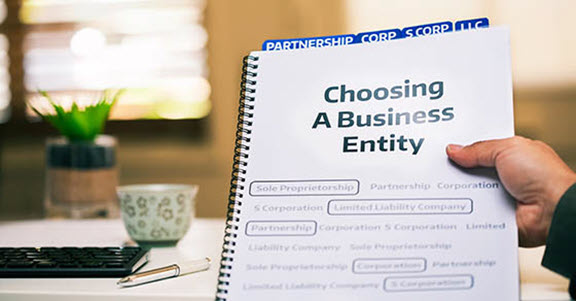
Starting a new business or restructuring an existing one involves numerous decisions, but one of the most critical is selecting the right business entity. This choice not only determines how your business is taxed but also influences your administrative responsibilities and regulatory compliance. While liability considerations are crucial, this article focuses on the tax implications of various entity types. For liability concerns, it’s always wise to consult with a legal expert.
Whether you’re launching a new venture or reevaluating your current setup, understanding how each business entity is taxed can help you make more informed decisions that align with your financial goals. Below is an overview of the most common business structures and how they impact your taxes.
1. Sole Proprietorship: The Simplest Structure with Full Personal Responsibility
A sole proprietorship is the easiest and least expensive business structure to establish. It is owned and operated by one individual, with minimal administrative overhead. Here are the key points to consider:
Taxation: The income generated by the business is reported on the owner’s personal tax return via Schedule C (Form 1040). The owner will pay self-employment tax (15.3%) on the income, as the business itself isn’t taxed separately. Additionally, the owner may qualify for a Qualified Business Income (QBI) deduction, potentially reducing the effective tax rate.
Compliance: There is minimal paperwork required aside from securing necessary licenses or business name registration. However, the owner is personally liable for any debts or legal issues arising from the business.
2. S Corporation: A Pass-Through Entity with Payroll Considerations
An S Corporation (S corp) is a tax classification that allows for pass-through taxation, meaning the corporation itself doesn’t pay taxes on profits. Instead, profits or losses are passed through to shareholders. This option offers both benefits and specific requirements:
Taxation: Profits from an S corp are passed to shareholders and reported on their individual returns via Schedule K-1. Shareholders who are also employees must be paid a reasonable salary, which is subject to payroll tax. However, additional profit distributions are not subject to self-employment tax. S corps are also eligible for the QBI deduction.
Compliance: To qualify as an S corp, you must meet several requirements, including having no more than 100 shareholders, all of whom must be U.S. residents. The entity must file Form 2553 to elect S corp status and must comply with corporate formalities like annual meetings and recordkeeping. Form 1120-S must also be filed.
3. Partnership: Shared Ownership with Pass-Through Taxation
A partnership involves two or more people who jointly own and operate a business. It can take several forms, including general partnerships, limited partnerships, and limited liability partnerships (LLPs).
Taxation: Like S corps, partnerships are pass-through entities. The business files an informational return (Form 1065) and income or losses are distributed to partners via Schedule K-1, which they report on their personal returns. General partners must pay self-employment taxes, while limited partners generally do not. Partnerships are eligible for the QBI deduction.
Compliance: Partnerships require a detailed partnership agreement, clear profit-sharing arrangements, and coordinated recordkeeping. While more complex than a sole proprietorship, partnerships offer flexibility in ownership and distribution.
4. Limited Liability Company (LLC): Flexibility with Liability Protection
An LLC combines elements of both corporations and partnerships, offering flexibility in management and liability protection for its owners, called members.
Taxation: By default, an LLC is taxed like a sole proprietorship if it has one member or as a partnership if it has multiple members. However, LLCs can choose to be taxed as an S corp or C corp by filing Form 8832 or Form 2553, giving owners control over their tax strategy. LLCs are also eligible for the QBI deduction if not taxed as a C corp.
Compliance: LLCs are less complicated than corporations but still require the filing of articles of organization and, in many cases, an operating agreement. They also have state-specific filing requirements and must meet annual reporting obligations.
5. C Corporation: Double Taxation with Growth Potential
A C Corporation (C corp) is a separate legal entity that provides the highest level of liability protection and scalability, making it ideal for businesses aiming for significant growth or seeking investors.
Taxation: C corps are subject to double taxation: the business pays corporate income tax on its earnings (currently at a 21% federal rate), and shareholders are taxed again on any dividends received. However, C corps can offer tax-deductible benefits like health insurance and retirement plans. Unlike other entities, C corps are not eligible for the QBI deduction.
Compliance: C corps have extensive administrative requirements, including the need for bylaws, shareholder meetings, and annual reports. They also face more stringent state and federal compliance obligations. However, C corps are well-suited for businesses seeking venture capital or planning for an IPO.
Adding Employees: Increased Compliance and Responsibilities
Regardless of your business structure, hiring employees increases your compliance obligations. You must obtain an Employer Identification Number (EIN) and withhold payroll taxes at the federal and state levels. Additionally, employers must manage employee benefits, tax deposits, and compliance with employment laws.
Choosing the Right Entity for Your Business
There is no one-size-fits-all answer when it comes to choosing the right business entity. The best choice depends on your specific goals, the complexity of your business, and how you want to be taxed. For instance, an LLC that elects S corp status can minimize self-employment taxes while offering operational flexibility.
For personalized guidance, consider working with both your tax advisor and attorney to ensure that your business structure aligns with your financial objectives and legal requirements. Contact us today to discuss how we can help you choose the best entity for your business and optimize your tax strategy.