• Who We Are
    • Firm Overview
    • Our Team
    • International
    • Life at Botwinick
    • Reviews
  • What We Do
    • Accounting
    • Assurance & Attestation
    • Business Consulting & Advisory
    • Contract Compliance
    • Forensic Accounting
    • Tax Compliance & Planning
  • Industries We Serve
    • Contractors
    • Dental Practices
    • Distribution, Logistics, & Warehousing
    • Manufacturing
    • Medical
    • Professional Services
    • Real Estate
    • Retail
    • Sports & Entertainment
    • Tech
  • Work With Us
  • Insights
  • Client Access
  • Contact
  • Client Login
  • Pay Online
  • Visit Our Office
  • LinkedIn
  • Facebook
  • Skip to primary navigation
  • Skip to main content
  • Skip to primary sidebar
    (201) 909-0090
Botwinick Logo
  • Who We Are
    • Firm Overview
    • Our Team
    • International
    • Life at Botwinick
    • Reviews
  • What We Do
    • Accounting
    • Assurance & Attestation
    • Business Consulting & Advisory
    • Contract Compliance
    • Forensic Accounting
    • Tax Compliance & Planning
  • Industries We Serve
    • Contractors
    • Dental Practices
    • Distribution, Logistics, & Warehousing
    • Manufacturing
    • Medical
    • Professional Services
    • Real Estate
    • Retail
    • Sports & Entertainment
    • Tech
  • Work With Us
  • Insights
  • Client Access
  • Contact
  • Show Search
Hide Search

Blogs

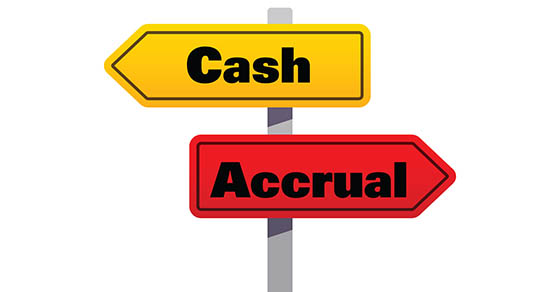
Two directional street signs on a pole, yellow “Cash” and red “Accrual,” symbolizing cash vs. accrual accounting options.

Cash vs. Accrual Accounting: Which Tax Method Is Best for Your Small Business?

Ken Botwinick, CPA | 07/07/2026

Choosing the right accounting method can have a significant impact on your small business’s taxes, cash flow, and overall financial strategy. One of the first decisions many business owners face is whether to use the cash or accrual accounting method for federal income tax purposes. While many larger businesses are required to use the accrual method, eligible small businesses may qualify to use the cash method, which can provide valuable tax-planning opportunities. However, the best choice depends on your business’s size, structure, and financial goals.

Does your business qualify for the cash method?

Under Internal Revenue Code Section 448(c), your business may be eligible for the cash accounting method if it had average annual gross receipts that don’t exceed a specific, inflation-adjusted threshold for the prior three-year period. For 2026, businesses with average annual gross receipts up to $32 million are eligible.

Some businesses may be eligible for cash accounting even if their gross receipts are above the threshold. Examples include S corporations, partnerships without C corporation partners, farming businesses and certain personal service corporations.

In addition, the Sec. 448(c) gross receipts test serves as the eligibility standard for several other tax provisions available to qualifying small businesses, such as:

  • Simplified inventory accounting,
  • An exemption from the uniform capitalization rules,
  • An exemption from the business interest deduction limit, and
  • The option to use the completed contract method (rather than the percentage-of-completion method) for certain long-term contracts.

When determining your business’s gross receipts, you may need to include those earned by certain related entities, such as those under common control. Special rules apply to organizations that have existed for less than three years. Also, tax shelters, including syndicates, don’t qualify for small business status, even if their gross receipts are below the threshold.

How do the methods differ?

The cash method often provides significant tax advantages. Because cash-basis businesses recognize income when received and deduct expenses when paid, they have greater control over the timing of income and deductions. For example, toward the end of the year, they can defer income by delaying invoices until the following tax year or shift deductions into the current year by accelerating expense payments.

In contrast, accrual-basis businesses recognize income when earned and deduct expenses when incurred, regardless of the timing of cash receipts or payments. Therefore, they have little flexibility to time the recognition of income or expenses for tax purposes.

The cash method also provides cash flow benefits. Because income is taxed in the year received, it helps ensure that a business has the funds needed to pay its tax bill.

However, for some businesses, the accrual method may be preferable. For instance, if your accrued income tends to be lower than your accrued expenses, the accrual method may result in a lower tax liability. Other potential advantages of the accrual method include the ability to deduct year-end bonuses paid within the first 2½ months of the following tax year and the option to defer taxes on certain advance payments.

Is it time for a change?

Even if your business would benefit from switching its accounting method, you should consider the administrative costs. Changing accounting methods for tax purposes may require IRS approval. And, if your business prepares its financial statements in accordance with U.S. Generally Accepted Accounting Principles, using the cash method for tax purposes would require you to maintain two sets of books (cash-basis tax records and accrual-basis financial reporting records).

Fortunately, you don’t have to make this decision by yourself. We can help determine the right method for your situation. Contact us to learn more.

© 2026

Share:
author avatar
Ken Botwinick, CPA Partner, CPA
Ken Botwinick, CPA is a Partner with Botwinick & Company, LLC and has been with the firm for more than 25 years. Ken specializes in providing accounting, tax, and business consulting services to dental and medical practices. He established the firm’s dental practice and is a sought-after lecturer at dental continuing education programs. Ken has his “finger on the pulse of the dental industry,” and with comprehensive experience in ownership transitions, he assists clients in the healthcare industry to reach their professional and financial aspirations and goals.
See Full Bio

About Ken Botwinick, CPA

Ken Botwinick, CPA is a Partner with Botwinick & Company, LLC and has been with the firm for more than 25 years. Ken specializes in providing accounting, tax, and business consulting services to dental and medical practices. He established the firm’s dental practice and is a sought-after lecturer at dental continuing education programs. Ken has his “finger on the pulse of the dental industry,” and with comprehensive experience in ownership transitions, he assists clients in the healthcare industry to reach their professional and financial aspirations and goals.

Primary Sidebar

Related Posts

Three colleagues collaborate at a desk, reviewing a laptop graph and open notebooks in a bright office.

Starting a Business? Choose the Right Legal Entity From Day One

Ken Botwinick, CPA | 06/29/2026

Start-ups must choose a legal entity for their business activities. The type of entity you select affects how the business is taxed and who may be held personally liable for its debts and obligations, among other things. Two popular options — …

Read More about Starting a Business? Choose the Right Legal Entity From Day One

Botwinick

Is Your Side Business a Real Business or Just a Hobby? Understanding the IRS Rules

Ken Botwinick, CPA | 06/24/2026

Many Americans earn extra income outside of their primary jobs. Whether you sell products online, provide consulting services, create content, perform music, or operate another side venture, it’s important to understand how the IRS views your …

Read More about Is Your Side Business a Real Business or Just a Hobby? Understanding the IRS Rules

Botwinick

Understanding 1031 Exchanges: A Smart Tax Deferral Strategy for Real Estate Investors

Ken Botwinick, CPA | 06/15/2026

For many real estate investors, developers, and business owners, selling a highly appreciated property can trigger a significant tax liability. Fortunately, Section 1031 of the Internal Revenue Code provides an opportunity to defer capital gains …

Read More about Understanding 1031 Exchanges: A Smart Tax Deferral Strategy for Real Estate Investors

Botwinick Logo

Contact Us

365 West Passaic Street

Suite 310

Rochelle Park, NJ 07662

info@botwinick.com
(201) 909-0090
(201) 909-8533

2700 N Military Trl

#240

Boca Raton, FL 33431

info@botwinick.com
(561) 787-0225
Boca Raton Accounting Firm

Follow Us

© Botwinick & Company, LLC. All Rights Reserved. | Privacy Policy | Terms & Conditions
Website Design & Development by SHJ
  • Pay Online

  • Visit Our Office

  • LinkedIn

  • Facebook